
Provenance Back to Benin
.png)
In November 2025, the bronze plaque from Benin, which was part of the The Fundatie Collection, will be returned unconditionally. Prior to the restitution, research into this object was conducted over a period of more than 15 years. Head of Collections Kristian Garssen and Curator of Contemporary Art Aude Christel Mgba take us through this research.
The first steps (2009 - 2020)
During this period, colonial contexts were not yet part of research into museum collections. Between 2009 and 2013, Museum de Fundatie participated in the national project on provenance research of museum acquisitions organised by the Dutch Museum Association. The aim was to determine whether objects in collections had a history of forced loss of ownership in the period 1933–45.
The Benin bronze in the collection was only investigated in the context of forced loss of ownership in the period 1933-45. With the help of the collection database and the museum's archive, among other things, the provenance was mapped out as far as possible. It was not until 2020 that the discussion about colonial heritage began. During that period, the plaque reappeared. From that moment on, the team set to work to further supplement the precise origin, authenticity and provenance history.
Provenance
A note by Dirk Hannema, founder of Museum de Fundatie, reveals that he purchased the relief in 1937 through art dealer Carel van Lier in Amsterdam, who had it on consignment from Parisian dealer Charles Ratton. That year, Van Lier organised a sales exhibition featuring various objects, including the fish relief. It also appears that the plaque was on display at the famous African Negro Art exhibition at MoMA in New York in 1935.
In addition, the relief bears a small, white-painted inventory number from Ratton. This number corresponds to the insurance list for the exhibition. An article in the magazine Cahiers d'art about the exhibition Bronzes et ivoires du Bénin at the Musée d'Ethnographie du Trocadéro in Paris (1932) mentions and depicts the relief, with Ratton as the owner. This means that the provenance from 1932 until the purchase by Hannema in 1937 is well documented. This virtually rules out the possibility of forced loss of ownership in the years 1933–45.
Little is known about its earlier provenance. In 1897, the Benin palace was looted. The exact journey of the plaque shortly after this looting is unknown, until it appeared in the aforementioned magazine in 1932.
Research has shown that in 1930, a fish relief was sold at an auction house in London that closely resembles this plaque. It is believed that Ratton acquired the object here, either through a middleman or personally. The auction catalogue states that this object came from the collection of a “gentleman” and was previously exhibited in the Brighton Museum. This supports the hypothesis that the relief ended up in England via a British officer who may have been involved in the looting.
Material research
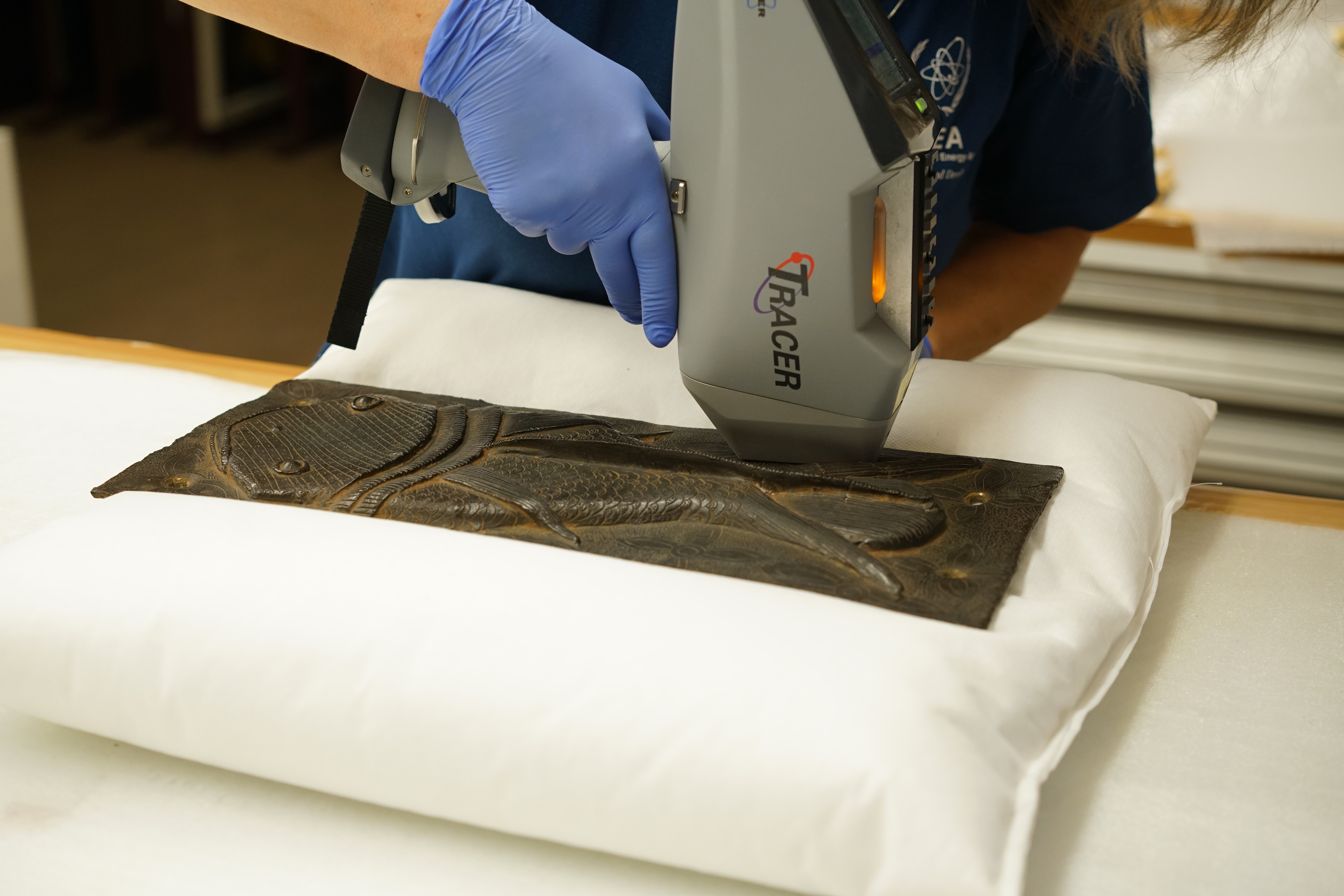
In July 2025, technical material research was carried out. An XRF scan, a method used to examine the chemical composition of a material, showed that the relief was made of brass, with no traces of nickel. This rules out the possibility that it is a modern reproduction and indicates that the work probably originates from historical Benin production.
A small sample was then chemically analysed by the NIGeL laboratory at VU University Amsterdam. The metal was found to consist of brass with small amounts of lead and tin, a composition that corresponds to the brass used in Benin and to European manillas — copper alloys that were brought to West Africa as a medium of exchange at the time.
An analysis of the ratio of isotopes (copper or lead) also shows strong similarities with that of manillas, an ancient currency, from the 18th-century shipwreck off Cape Cod, further confirming the historical authenticity of the relief.
Although much has become clear about the object, including confirmation of its origin and authenticity, one crucial question remains unanswered: how did the object end up in Paris in 1932 after the looting of 1897?